Taehyeong Kim and Wonjin Oh publish in Chemical Engineering Journal
A paper co-first-authored by Taehyeong Kim and Wonjin Oh (M.S. students, CAMP Lab) has been published in Elsevier’s Chemical Engineering Journal (2025 JCR IF 12.5, JCR Q1, top 3.6% in Engineering, Chemical). Congratulations to both.
Paper
- Title: Disrupting the crack-delithiation feedback loop in dry-processed high-nickel cathodes through early-stage granule engineering
- Journal: Chemical Engineering Journal 545 (2026) 179740 — Special issue “Emerging Functional Materials”
- Authors: Taehyeong Kim‡, Wonjin Oh‡, Seokjun Kim, Chanho Lee, Jinhyung Kim, Minseok Kim, Jungmin Lee, Yunhee Jang, Minkyu Kim, Patrick Joohyun Kim, Taeseup Song, Ungyu Paik, Dongsoo Lee*, Junghyun Choi*, Seho Sun* (‡ equal contribution, * corresponding authors)
- Collaborators: Gachon University, Kyungpook National University, Hanyang University
- Available online: 21 July 2026
- Link: https://doi.org/10.1016/j.cej.2026.179740
One-line conclusion
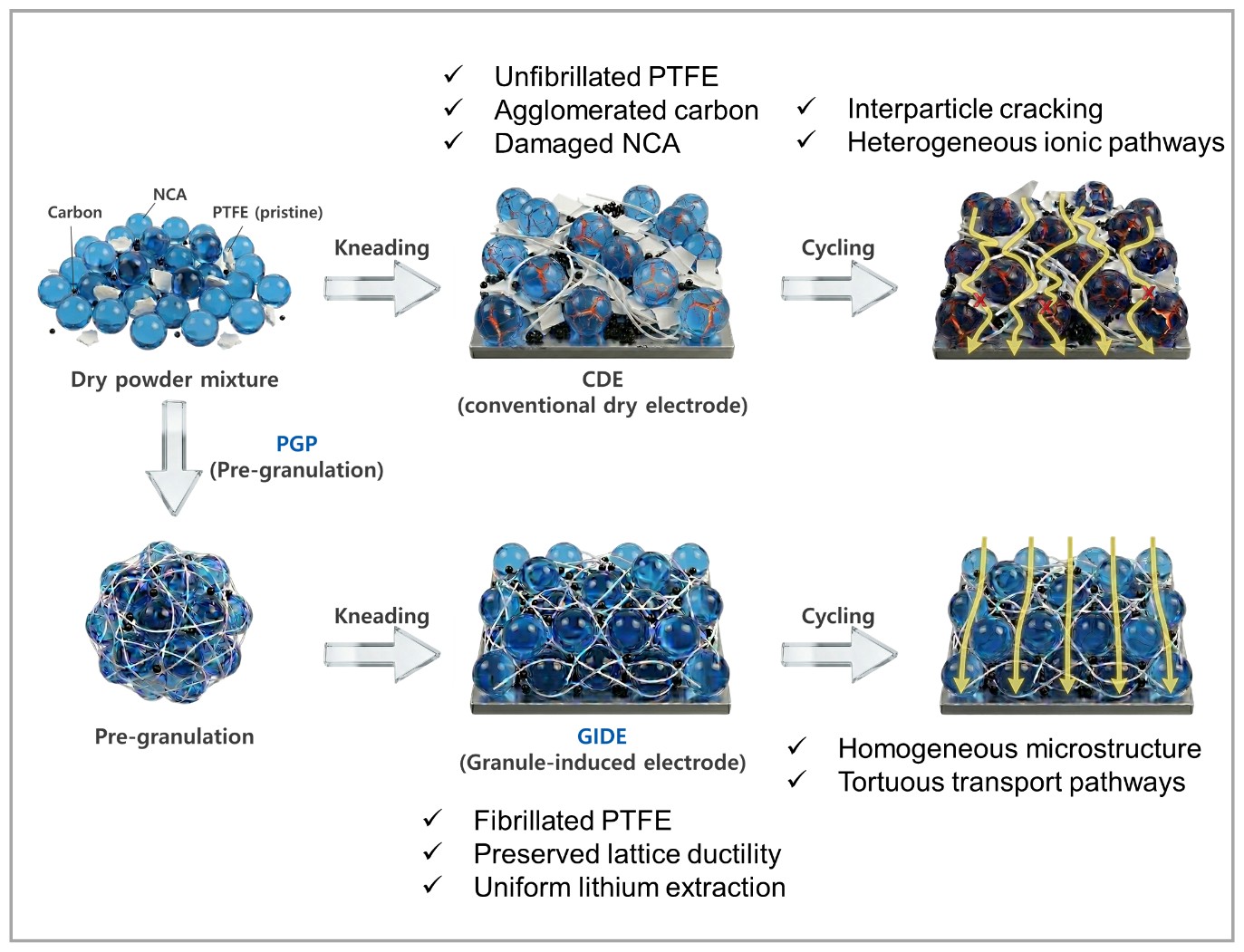
Forming a PTFE fibril network inside NCA granules before kneading lets the granules absorb and redistribute the stress of dry processing, which breaks the self-reinforcing loop between particle cracking and non-uniform delithiation.
The granule-induced dry electrode (GIDE) shows 77% lower charge-transfer resistance and 230% higher toughness than the conventional dry electrode (CDE), retains 86% of its capacity after 100 half-cell cycles at 10 mAh cm⁻² (the CDE fails at 60 cycles), and NCA‖graphite full cells retain 86.1% over 300 cycles. DFT and molecular dynamics support the mechanism: uniform delithiation preserves lattice ductility and lowers internal von Mises stress.